

From Code to Commerce to AI
The Evolution of a Technology Entrepreneur, Digital Commerce Strategist & Technical Product Leader
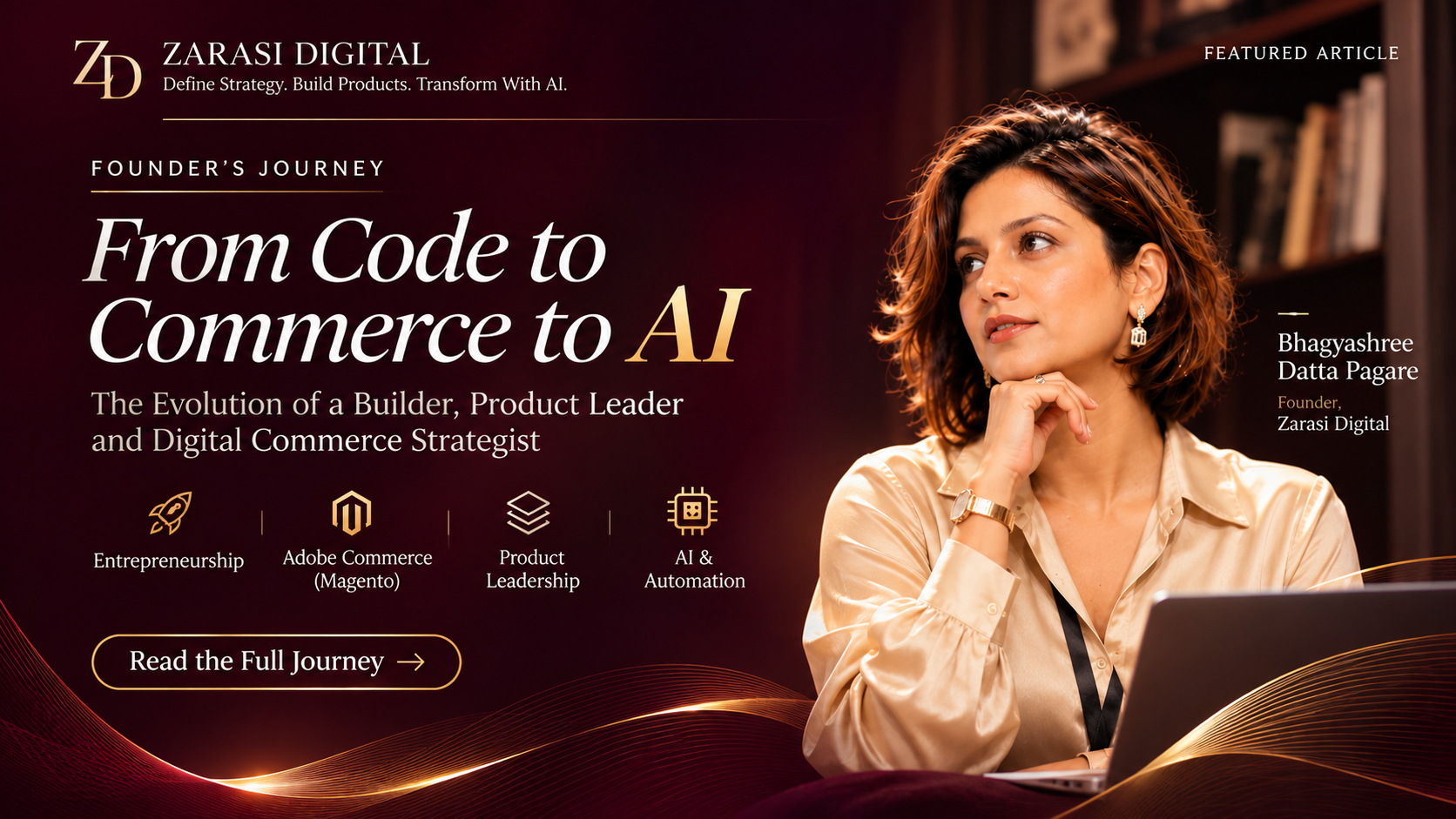
From founding a technology venture to leading complex digital commerce initiatives, Bhagyashree Datta Pagare's journey illustrates how entrepreneurial thinking, technical understanding, and product leadership can converge in an increasingly AI-driven world.

In this article · 9 sections
Every career has a defining question. For Bhagyashree Datta Pagare, that question has evolved from "How do we build something useful?" to "How do we build intelligent systems that create lasting business value?"
Her professional journey has not followed a single technology, job title, or conventional career trajectory. Instead, it has moved through entrepreneurship, digital product development, business analysis, enterprise content management, Adobe Commerce (Magento), and artificial intelligence.
Today, as a Technical Product Owner specializing in e-commerce and the founder of Zarasi Digital, Bhagyashree operates at the intersection of business strategy, product architecture, technology delivery, and intelligent automation.
Her evolution reflects a broader transformation happening across the technology industry: the shift from building digital platforms to creating interconnected, increasingly intelligent business ecosystems.
The Entrepreneurial Beginning: Learning to Think Beyond Technology
Long before enterprise commerce became central to her career, Bhagyashree explored technology through entrepreneurship.
In 2017, she founded Minnano Consultancy, an initiative that allowed her to experience the realities of building and operating a technology business.
One of its notable initiatives was TestNinja, an educational technology product that reached more than 5,000 students.
Building a product from an idea introduced her to questions that remain relevant throughout her career: What problem are we solving? Who are we solving it for? How do we translate a vision into something people can actually use?
Entrepreneurship offered something that conventional technical roles do not always provide: direct exposure to the relationship between product decisions, operational constraints, customer needs, and business sustainability.
It also shaped her understanding that successful technology requires more than functional software.
It requires a clear purpose, an understanding of users, disciplined execution, and the ability to adapt.
These early experiences laid the foundation for her eventual transition into enterprise product and digital commerce leadership.
Entering Enterprise Digital Transformation
As her career progressed, Bhagyashree moved into increasingly complex enterprise technology environments.
During her tenure at Fulcrum Digital, she worked on digital commerce initiatives involving Adobe Commerce and Magento, contributing to projects across different business domains.
The experience introduced her to the intricacies of enterprise e-commerce, where a seemingly straightforward customer journey can depend on multiple interconnected systems.
Product catalogs, inventory, pricing, checkout, payment gateways, customer information, integrations, and fulfillment processes must operate together.
For a business analyst or product professional, understanding these dependencies requires more than gathering requirements.
It demands the ability to connect business processes with system behavior, anticipate operational consequences, and communicate effectively across technical and nontechnical teams.
Adobe Commerce became an important part of this evolution.
Rather than viewing Magento simply as an e-commerce platform, Bhagyashree began approaching it as a critical component of a larger business operating environment.
This distinction would become increasingly important as her responsibilities expanded.
Beyond Magento: Expanding into Enterprise Digital Experience
Her subsequent work at Icreon broadened her exposure to enterprise content management and digital experience platforms.
Working with technologies such as Sitecore XM Cloud and Optimizely introduced new dimensions of digital transformation.
Commerce platforms primarily enable transactions, while content management and digital experience systems shape how customers discover, understand, and engage with brands.
Modern enterprises increasingly require both capabilities to work together.
This exposure helped Bhagyashree develop a more platform-agnostic perspective.
Adobe Commerce, Sitecore, Optimizely, and emerging composable architectures each address different aspects of the digital ecosystem.
The important question is not necessarily which platform is most powerful.
It is which architecture, integration strategy, and operating model best serve the organization's objectives.
Her experience across multiple platforms reinforced the value of thinking in terms of business capabilities rather than technology labels.
The Transition from Business Analysis to Technical Product Ownership
One of the most significant developments in Bhagyashree's professional journey has been her evolution into technical product ownership.
Business analysis taught her how to understand requirements, map processes, investigate gaps, and define solutions.
Technical product ownership introduced broader accountability for prioritization, delivery, operational outcomes, and the continuous evolution of digital products.
In her current role as a Technical Product Owner in e-commerce, she works across a multi-market Magento commerce environment, where product decisions intersect with technical stability, customer experience, integrations, and business operations.
The responsibilities extend beyond maintaining a backlog.
They include coordinating technical delivery, improving operational visibility, strengthening commerce reliability, and identifying opportunities for automation.
In enterprise commerce, small technical failures can have substantial business consequences.
A product may appear available but cannot be purchased. An integration may complete without producing the expected business outcome. A checkout issue may affect only one market or customer segment.
These challenges have reinforced an important principle in her product philosophy:
A digital product is not successful simply because it has been deployed. It succeeds when it continues to deliver the intended business outcome reliably.
That perspective marks the transition from managing features to taking ownership of product outcomes.
Discovering the Next Frontier: AI and Intelligent Commerce Operations
As artificial intelligence has accelerated, Bhagyashree's interest has increasingly focused on its practical application to enterprise systems.
For her, the most compelling opportunity is not merely generating content or adding conversational interfaces.
It is improving how digital operations are monitored, understood, and managed.
Traditional e-commerce operations often rely on reactive processes.
An issue occurs. A customer reports it. A support ticket is raised. A technical team investigates. A fix is developed and deployed.
But what if intelligent systems could identify emerging problems before customers experience them?
What if commerce teams could continuously monitor product availability, pricing consistency, checkout functionality, catalog quality, and integration behavior?
What if AI-assisted workflows could connect operational signals with business context, helping teams prioritize the problems that matter most?
These questions have shaped Bhagyashree's exploration of automated commerce quality monitoring, intelligent support workflows, technical analysis, and AI-assisted product operations.
The opportunity is not to remove human judgment from product management.
It is to improve the quality, speed, and consistency of the information available to people making decisions.
AI, in this context, becomes an operational capability rather than an isolated feature.
From Technical Execution to Strategic Thinking
The intersection of product leadership and AI has also influenced how Bhagyashree approaches business transformation.
Technology initiatives frequently begin with a platform decision.
An organization selects a commerce solution, implements a CMS, integrates a payment provider, or introduces a new automation tool.
But sustainable transformation requires a broader view.
What business capability must improve?
Which processes create unnecessary complexity?
Where does manual intervention introduce risk?
What should be automated, and what should remain under human control?
How will success be measured?
These are product and business questions as much as technical ones.
Bhagyashree's experience across entrepreneurship, enterprise platforms, and product delivery has encouraged an approach that starts with the desired outcome and works backward toward the architecture, processes, and technology needed to achieve it.
Zarasi Digital: Bringing the Journey Together
The development of Zarasi Digital represents another chapter in this professional evolution.
Positioned around digital transformation in e-commerce, CMS, and AI consulting, Zarasi Digital brings together the areas that have shaped Bhagyashree's career.
Its philosophy is captured in three statements:
Define Strategy. Build Products. Transform With AI.
The positioning reflects an ambition to help organizations connect strategic direction with practical technology execution.
It also represents a platform-agnostic approach to digital commerce.
Rather than limiting transformation to a single technology ecosystem, the focus includes Adobe Commerce, Magento, modern storefront architectures, content platforms, and AI-enabled operational capabilities.
For Bhagyashree, the relationship between strategy and execution remains central.
A transformation roadmap has limited value without the ability to deliver it.
Equally, technical implementation has limited strategic value when it is disconnected from business objectives.
The goal is to bring these disciplines closer together.
Sharing Knowledge and Building the Next Generation
Bhagyashree's journey has also included opportunities to share her professional experiences beyond the workplace.
She has delivered a session at her college as an alumni speaker, engaging with students and contributing insights from her entrepreneurial and technology career.
Knowledge sharing is a natural extension of her interest in product thinking, technology transformation, and the evolving role of professionals in the AI era.
As the technology landscape becomes more complex, practical experience can help bridge the gap between academic learning, emerging technologies, and real-world business challenges.
Her interests as a prospective industry conference speaker include AI-powered commerce operations, Adobe Commerce architecture, technical product leadership, and the future of digital transformation.
Looking Ahead: The Future Belongs to Connected Thinking
The next generation of digital commerce will not be defined by any single platform.
It will be shaped by how effectively organizations connect customer experience, product strategy, data, automation, architecture, and human decision-making.
Artificial intelligence will influence how systems are monitored, how teams work, and how digital products evolve.
Yet the fundamentals of successful product leadership will remain relevant: understanding problems, making informed decisions, managing complexity, and delivering measurable value.
Bhagyashree Datta Pagare's professional journey reflects this convergence.
From building an educational technology venture to navigating enterprise Magento ecosystems, expanding into digital experience platforms, and exploring AI-driven operations, each chapter has added a new dimension to her perspective.
Her evolution is not simply a transition from one role to another.
It is a progression from understanding technology as something to build, to understanding products as something to own, and ultimately to exploring intelligent systems as something that can transform how businesses operate.
The next chapter is not about choosing between technology, product, and AI. It is about bringing all three together to create meaningful business outcomes.